




Volunteer Group Helps in the Battle for Native Habitat
I don’t want to overstep and claim on behalf of our organization that we’re the leading authority on non-native, invasive plant removal, but I’d be remiss if I didn’t say we have put in the hours across our organization to earn the claim that we at least know a thing or two about the matter.
Conversations on conservation and ecological competition shouldn’t be had without addressing this esteemed foe and challenger. And like a well-established adversary, the proper respect must be given to begin addressing potential solutions for how to mitigate such a threat.
"If you know the enemy and know yourself, you need not fear the result of a hundred battles. If you know yourself but not the enemy, for every victory gained you will also suffer a defeat. If you know neither the enemy nor yourself, you will succumb in every battle." — Sun Tzu, The Art of War
Meet the Enemy: Invasive Plants in Jefferson County
Nonnative, invasive plants persist within and pervade much of the Southeast region of the U.S., disrupting ecosystem food webs, habitats, soil integrity, and other biotic factors. Some of you may already be familiar with some of these plants; Japanese Kudzu, East Asian Privet, Heavenly Bamboo, Japanese Stiltgrass, and Mulberry Weed just to name a few. An organized, trackable, and aggressive approach is the only way to effectively address these ecosystem detractors.
Meet the Ruffner Mountain Volunteer Invasive Removal Crew
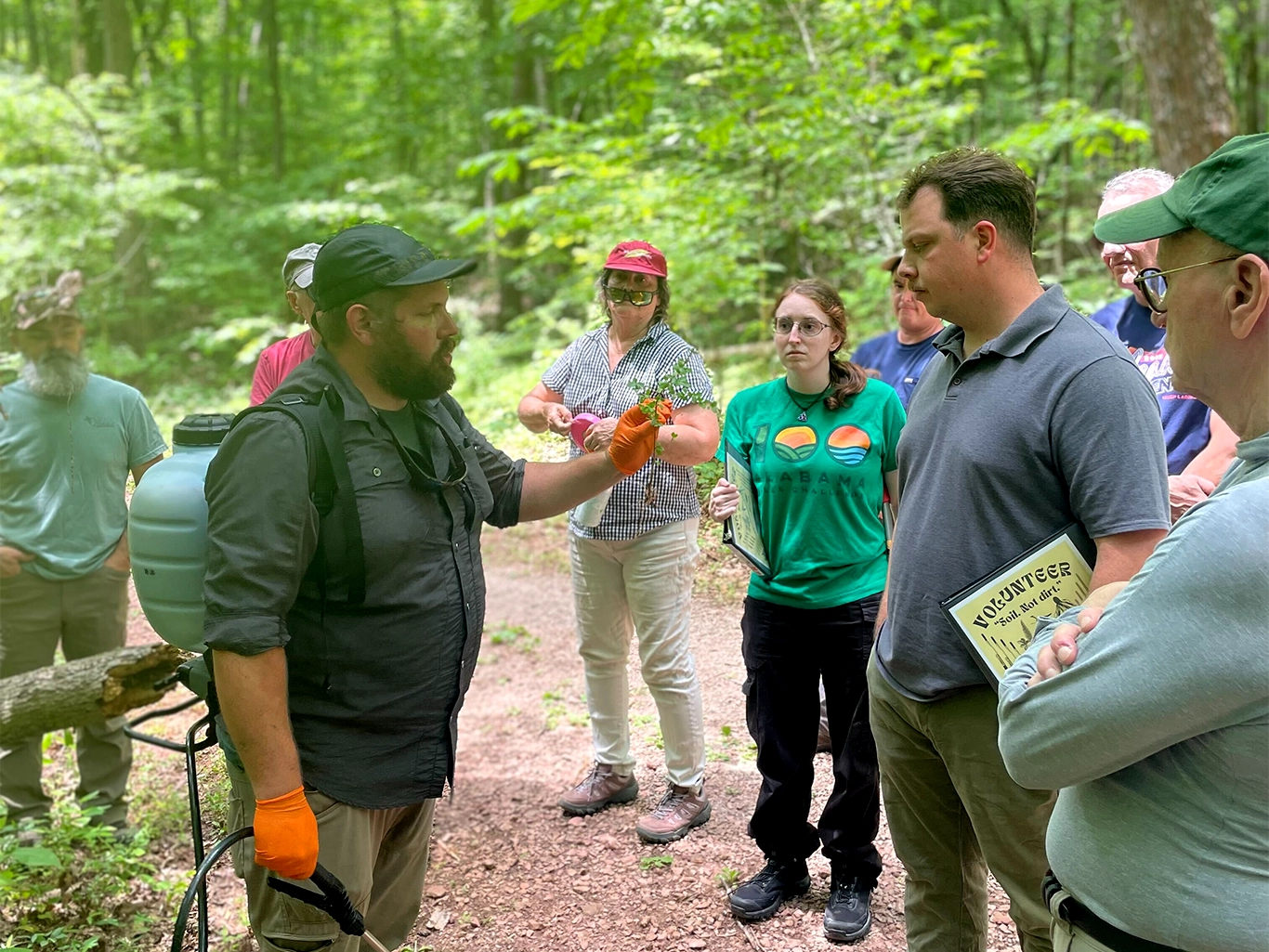
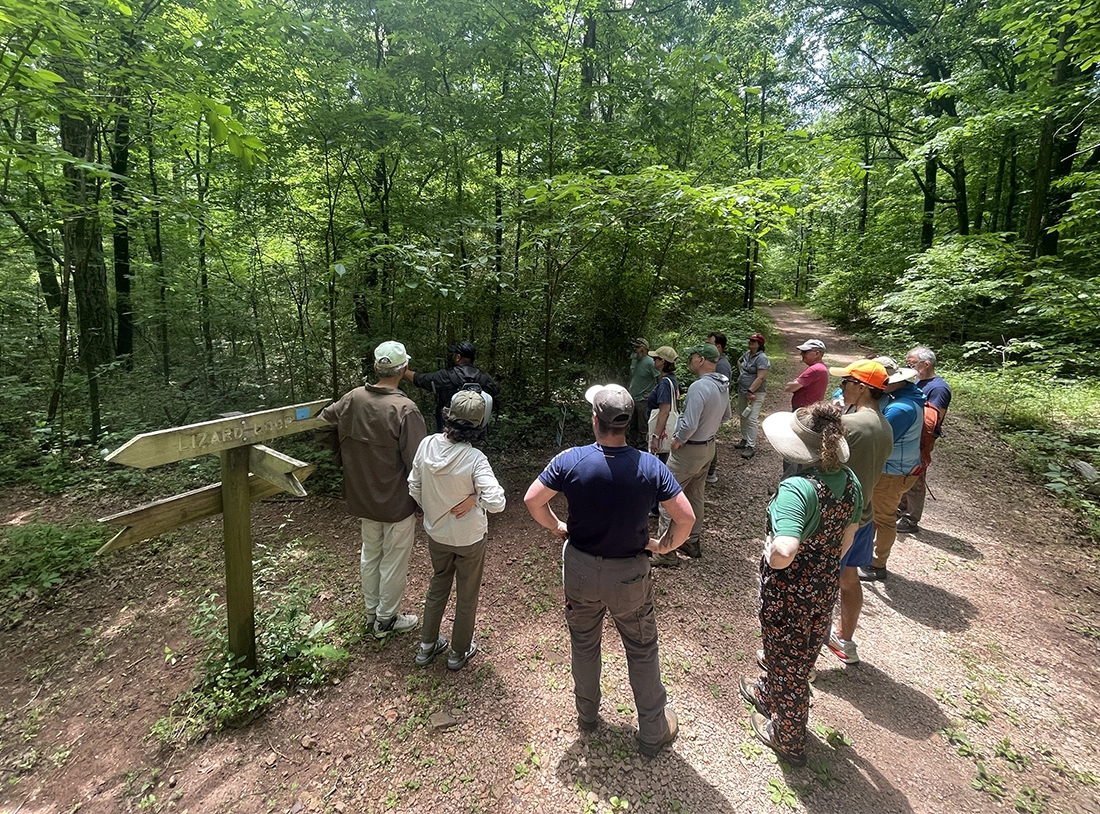
One such approach we have conjured up has been our ALIPC-funded (Alabama Invasive Plant Council) volunteer group called the Ruffner Mountain Volunteer Invasive Removal Crew (RMVIRC). This SEAL-esque trained group of volunteers is equipped with the knowledge and resources to tactfully address some of these invasive plants via localized herbicidal foliar application.
Yes, We Use Herbicide. Here’s Why.
You may be reading this and asking yourself, “Really, an organization that aims to preserve Jefferson County greenspaces uses herbicide to treat plants?” Yes. Selectively and ethically, of course. The methods and treatments our trained staff and volunteers use follow a strict protocol according to the environmental factors at play and, above all else, prioritize the health of native plants and their habitats. Multiple methodologies have been scrutinously trial-run through the years to yield a safe yet aggressive approach to the ongoing eradication of non-native, invasive species. Our trained RMVIRC volunteers have joined this effort to see noticeable change within one of our management units at Ruffner Mountain along the Lizard Loop trail. The primary invasive plant we’ve had them target is East Asian Privet (Ligustrum sinense).
The Fight Against East Asian Privet and Other Invasive Species
East Asian Privet is pervasive in Jefferson County, Alabama. You see it while driving up and down highways, taking over the understories and edge habitats of forested areas. A single individual under the right conditions can grow to be 30-40 feet, forming dense thickets that would be nearly impossible to uproot mechanically without the aid of heavy machinery that would only serve to further disrupt the area. It has a low germination rate of 5-27%, but it propagates aggressively through root suckers, untreated stump sprouts, and intentional cutting, achieving a success rate anywhere between 85-100% (Mississippi State University Extension). Oftentimes, a collective beast this big requires multiple treatments across multiple years to start seeing real beneficial change.
Thankfully, our volunteers have been hard at work this summer and will continue this fall and winter to keep pushing aggressively. From my perspective, and that of our Director of Land and Water Conservation, Charles Yeager, it has been very encouraging to see our volunteers recognize and understand the importance of this initiative.One of the bigger hurdles to jump over is ensuring the educational component remains a priority. Without the educational focus, we may easily lose sight of the goal – teaching and learning about our native environment with our community – and sacrifice the project’s integrity. Honestly, that’s a lesson for life in and of itself.
Volunteers Behind the Progress
In response to the question “What’s your ‘why’ for being a part of this group?” JCG member and dedicated volunteer Micah DeRocher answered, “I’m an advocate for habitat restoration. I love the thought of seeing Ruffner returning to a thriving, functioning ecosystem free from invasive species that are harmful and serve no ecological function to our region.”
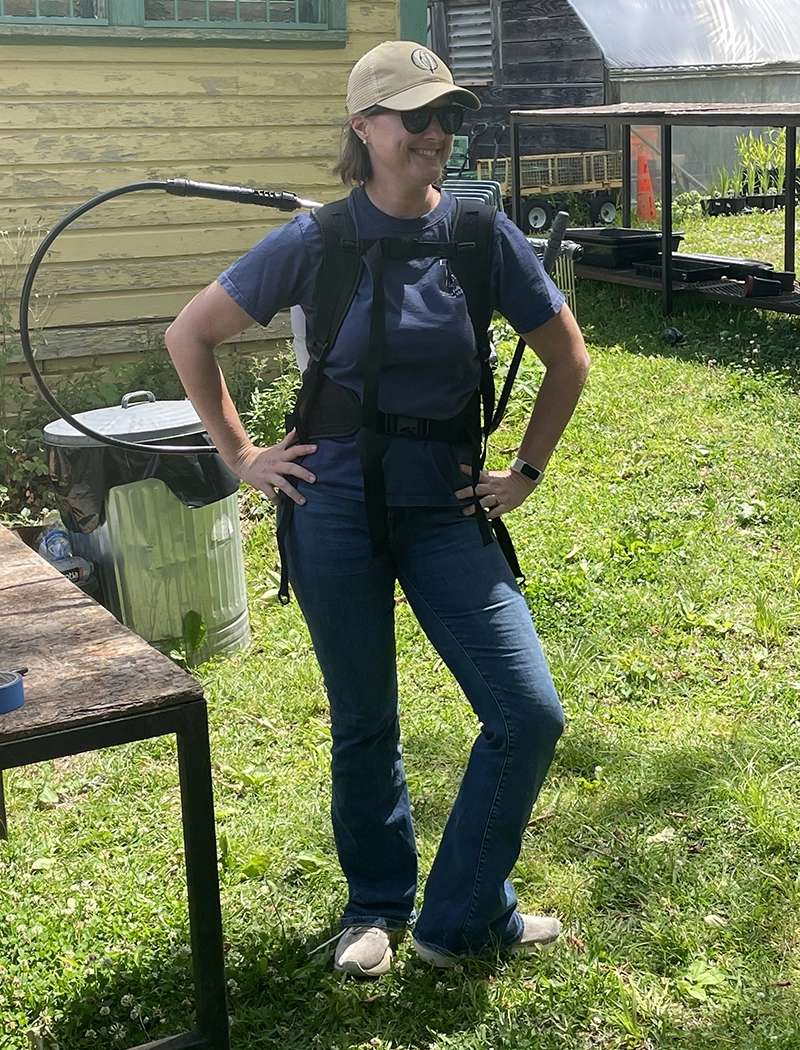
I asked another one of our esteemed RMVIRC volunteers, Emily Yancey, what has been the most enjoyable part of this volunteer experience for her. Emily responded, “I've really enjoyed watching the progress over time. Having a defined area that you've seen since the beginning and keep coming back to allows you to see real ecological impact. Working together as a group, we see that progress happen faster, which feels really validating.”
Sidebar: Both Micah and Emily have been heavily involved with our volunteer program in other initiatives like our end-of-year mailer campaigns, Native Plant Sale, garden workdays, and docent programs. We should all strive to be more like Micah and Emily.
In addition to Emily and Micah, Buzzy Brown, David Hotham, Roger Mainor, and Doug Shaddix have joined this targeted fight against non-native invasives.
Want to Join Us in Protecting Our Greenspaces?
We plan to keep this volunteer initiative going and growing, so be on the lookout for future training sessions so you can become involved in this fight.
We’re in the nonnative, invasive plant removal business, and cousin, business is a-boomin’.
If you’re not up for the fight against non-native species, there are plenty of other ways you can join us in protecting our greenspaces. We’re incredibly grateful for our volunteers, who play an integral role in keeping these natural areas healthy and thriving. Find more information about volunteer opportunities.
Take care out there,
Sloan Miles
JCG Volunteer Coordinator